TEAS Math Concept: Absolute Value
The mathematics component of the TEAS test consists of 38 questions covering two main topics—Numbers and Algebra and Measurement and Data. I will be creating free lessons for the more challenging or tricky concepts you may not have studied in a long time as a refresher. Rather than creating lessons on all content within the mathematics section, I am focusing first on the harder content.
One excellent study habit is spending your available time studying material that is hard instead of practicing the trivial problems.
In this first lesson, I will review something you may not have seen since high school algebra class—Solving Equations with Absolute Value.
Before we can solve equations with absolute value, let us just think about what absolute value even means in general.
What is Absolute Value?
When I think of absolute value, I think of how far a value from zero on a number line. If I want to know the absolute value of five, I find the distance between five and zero on the number line.

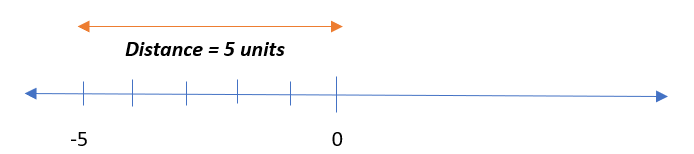
The same logic from above can also be applied to negative numbers as well. If I want to know the absolute value of -5, we will have a similar result. The distance between negative five and zero is 5 units as shown below.

How Do We Solve Absolute Value Equations?
Since now we have a better understanding of what absolute value does, we can solve an equation and, not just get an answer, but we can understand what the solution means to help retain the information.
Here is a sample TEAS Test Mathematics Question.
Solve the following equation:

Solution:
Ignore the absolute value or “open” the absolute value. Then set the equation equal to -19 and 19.
Recall, the conceptual concept of absolute value is a distance between a value and zero on the number line.
We want to account for both instances or distances the equation can be resolved—one where the equation is set to 19 and the other where the equation is set to -19.

When we solve the equations, we just need to add 5 to both sides, which result in the following:

Dividing both equations by 2, we get the following result:

Often the solution set will be given in set builder notation like this:
{-7, 12}

Comments